

Fence
Installation
OUR SERVICES
Fence Installation and Fence Selling
ALUMINIUM
An aluminium fence is just the thing to add style, modernity and prestige to your backyard, perfect for surrounding an in-ground pool, for example.
GLASS
Whether you’re enclosing a swimming pool or a balcony, a tempered glass fence offers durability and a quality look. Also available: a beautiful glass railing.
PVC
Opt for a combination of aesthetics and sturdiness with a PVC fence. Economical, hardwearing and very easy to maintain.
OTHERS
We can help you with all your projects, from fencing and railings to privacy walls and more.
The Work
of our passionate team
Get inspired for your next project!
How can we spruce up your space this summer? A new fence? New railings? A privacy wall?


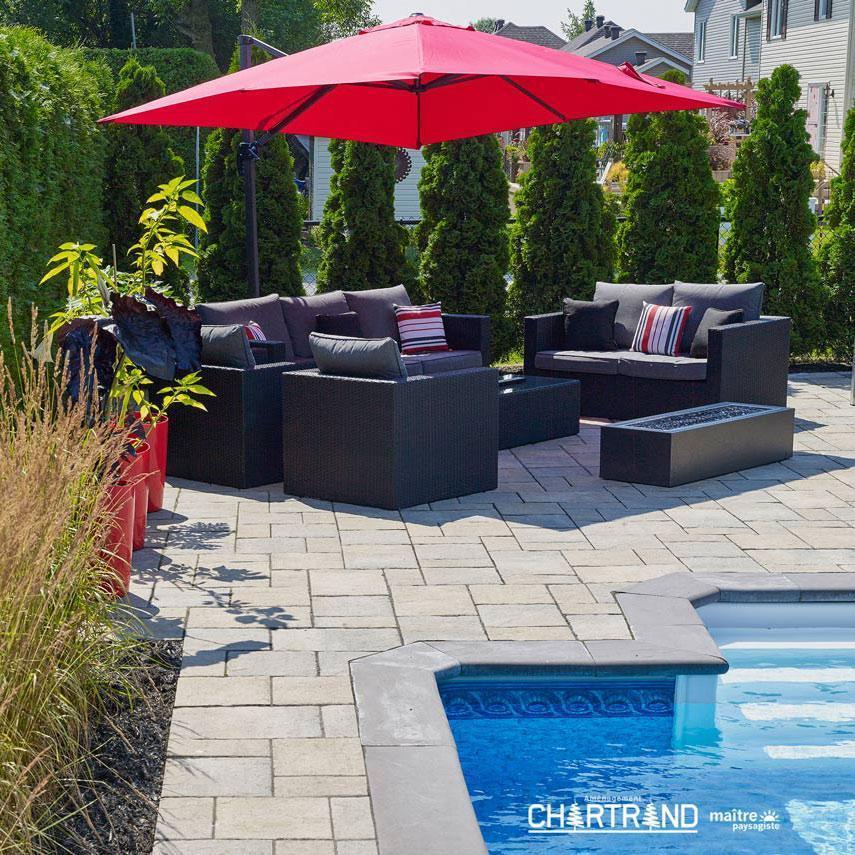
Safety and elegance.
Secure your space now!
Contact us
to transform it!

FAQ About Fencing
To maximize privacy in a Quebec backyard, the best options are solid PVC (opaque) fencing, composite fencing, horizontal-slat aluminum privacy walls, and solid wood fencing. PVC and composite offer full coverage with no maintenance, while wood creates a warmer look but requires regular upkeep (staining or painting every 2 to 5 years).
Aluminum with angled slats (louver style) offers a good compromise between privacy, ventilation, and modern design. Height is also a key factor. In Quebec, most municipalities allow a maximum height of 6 feet (1.8 m) for a backyard fence, which is sufficient to block neighbours’ views at eye level. For even more privacy, some homeowners combine a 6-foot fence with tall plantings (cedars, ornamental grasses) or a pergola with climbing plants. An aluminum or composite privacy wall is also an excellent alternative, offering a more upscale look.
Aluminum and PVC are the two most popular fence materials in Quebec for residential properties, and each has its strengths. Aluminum is more durable, offers a more modern and sophisticated look, and comes in over 120 models and colours. It does not rust, does not warp in the sun, and holds up very well to Quebec winters. Its price ranges from $45 to $150 per linear foot installed, depending on the model. Its lifespan can exceed 30 years with minimal maintenance (an occasional rinse).
PVC is generally more affordable for basic models, but prices have risen over the years: expect between $90 and $150 per linear foot installed in 2026 in Quebec. It provides good coverage (ideal for privacy), resists corrosion, and usually comes with a 20-year colour warranty. However, PVC can become brittle in very cold weather and may slightly discolour over the years due to UV exposure. For the best long-term value and a look that ages more gracefully, aluminum is often the better choice, especially for pool fencing and high-end projects.
The cost of fence installation in Quebec varies by material, height, and length. Here are the price ranges per linear foot (materials and installation included) in 2026:
| Material | Price per linear foot (installed) |
| Chain-link (Frost) | $25–$40 |
| Treated wood | $25–$70 |
| Ornamental iron | $50–$70 |
| Aluminum | $45–$150 |
| PVC | $90–$150 |
| Composite | $85–$155 |
For a typical backyard of 100 to 150 linear feet, the total budget can therefore range from $2,500 to over $20,000. Several factors influence the price beyond material: soil type (rock, clay), number of corners and gates, terrain slope, chosen height, and accessories (privacy slats, premium hardware). Travel fees may also apply if your property is far from urban centres. The best approach is to get at least two or three quotes to compare, as price differences between installers can be significant for identical projects.
Aluminum is the lowest-maintenance fence material in Quebec. It does not rust, rot, or discolour significantly, and never needs to be repainted or stained. A simple power rinse once a year is enough to keep it clean. PVC and composite are also very low-maintenance options: occasional cleaning and no painting or staining required throughout their lifespan.
In contrast, wood fences require more sustained maintenance. Treated wood or cedar must be stained or varnished every 2 to 5 years to protect against moisture, UV rays, and insects. Without this maintenance, wood greys, splits, and deteriorates quickly in Quebec’s climate. Ornamental iron fences hold up well but may require anti-corrosion treatment if the protective coating is damaged. For a homeowner who wants to install a fence and forget about it for decades, aluminum remains the most practical choice.
In the vast majority of Quebec municipalities, yes, a permit is required to install or replace a residential fence. Municipal zoning bylaws govern maximum height, permitted materials, setback from property lines, and fence style. For pool enclosure fences, a permit is practically always required, whether it is a new installation or a modification to an existing enclosure.
Before starting work, you must also obtain an up-to-date location certificate to know your property’s exact boundaries and avoid encroaching on your neighbour’s land. A call to Info-Excavation (1-800-663-9228) is also recommended before digging, to locate underground cables and pipes. The permit application process varies by city but typically includes a site plan showing the fence’s location and dimensions. Permit fees are generally modest.
The maximum height for a residential fence in Quebec is determined by municipal bylaws, which vary by city. Generally, the maximum permitted height is 2 metres (approximately 6 feet) in the backyard and 1 metre (approximately 3 feet) in the front yard. Some municipalities allow up to 1.5 metres in the front yard if the fence is open (non-opaque). For side yard fences, the permitted height often depends on the position relative to the front of the house.
It is essential to verify your municipality’s specific regulations before purchase and installation, as exceptions are frequent. Some boroughs have stricter standards regarding materials (for example, chain-link may be prohibited in the front yard) or colours. If your property is in a residential development with a declaration of co-ownership, additional restrictions may also apply. A professional installer in your area will be familiar with local regulations.
In Quebec, the fence must be installed entirely within your property limits, unless there is a written agreement with your neighbour to place it directly on the property line. If it is on the property line, it becomes a shared (mitoyenne) fence and both owners share ownership and maintenance responsibilities. To know your property’s exact boundaries with certainty, a location certificate prepared by a land surveyor (arpenteur-géomètre) is indispensable. In practice, many installers recommend placing the fence a few inches inside your property line to avoid any conflict with the neighbour.
This gives you full control over the fence (material, style, maintenance) without needing the neighbour’s agreement. If you decide to build a shared fence on the property line, both neighbours should ideally agree on the material, height, and cost-sharing. In case of disagreement, the Civil Code of Quebec provides that each owner may require the construction of a shared fence, with costs split equally.
According to the Civil Code of Quebec, the costs of building and maintaining a shared fence (installed directly on the property line) are split equally between the two neighbouring owners. If one owner wants a shared fence built and the neighbour refuses to contribute, they can still require construction under the law, and the neighbour will be obligated to pay their half.
However, this situation can create tension, so a friendly discussion is always preferable. If you choose to install the fence entirely on your own property (a few inches from the property line), you bear the full cost but are also the sole owner. You then have full control over material, style, and maintenance. This is the option many Quebec homeowners choose to avoid complications. If an existing shared fence needs repair or replacement, both neighbours share the costs, unless one party caused the damage through negligence.
A quality aluminum fence can last between 30 and 50 years in Quebec, making it one of the most durable materials on the market. Aluminum does not rust, rot, or warp due to moisture or freeze-thaw cycles. Unlike iron or steel, it requires no anti-corrosion treatment, contributing to its exceptional longevity with virtually no maintenance. Most manufacturers offer a 20-year warranty against normal aging on aluminum products, which gives a good indication of the material’s reliability.
The factory-applied paint or powder coating retains its colour for many years without chipping or significantly discolouring. Actual lifespan depends on product quality, profile thickness, and exposure to the elements, but under normal Quebec conditions, aluminum outperforms wood (10 to 20 years), PVC (20 to 25 years), and ornamental iron (15 to 20 years without maintenance).
FAQ about privacy wall
A privacy wall is designed specifically to block the view and create a private space, whereas a fence can serve multiple purposes: marking property boundaries, securing a space (pool, children, pets), or simply adding a decorative element. A privacy wall is generally opaque and more visually substantial than a standard fence. It is often made of solid composite, tight-slat aluminum, or wood panels, and may incorporate architectural features such as trellis sections or integrated planters.
In terms of Quebec regulations, a privacy wall is generally subject to the same municipal rules as a fence regarding maximum height and placement. The main difference lies in aesthetics and price: a high-end aluminum or composite privacy wall typically costs more than an open fence of the same material, but the visual effect and level of privacy are noticeably superior. It is an ideal solution for backyards in urban areas or on properties with close neighbours.
The maximum height for a privacy wall in Quebec is governed by the same municipal regulations as fences. Generally, the permitted height is 2 metres (approximately 6 feet) in the backyard and 1 metre (approximately 3 feet) in the front yard. Some municipalities distinguish between opaque structures (such as a solid privacy wall) and open fences, sometimes allowing a more generous height for partially transparent structures.
If you need more privacy than what the regulated height allows, there are creative alternatives: combine a 6-foot privacy wall with tall plantings (cedar hedges, ornamental grasses, hardy bamboo), add a pergola with a canopy or climbing plants above a terrace, or install shade sails. A certified landscaper can design a solution that respects regulations while maximizing your privacy.
The most popular materials for outdoor privacy walls in Quebec are aluminum (horizontal or vertical slats), composite, and wood (cedar or treated lumber). Aluminum offers a modern, contemporary look, requires no maintenance, and perfectly withstands Quebec’s weather for 30 years or more. Composite mimics the appearance of wood without the maintenance drawbacks and lasts between 15 and 25 years depending on quality. Cedar is appreciated for its natural, warm look but requires regular maintenance.
The choice of material depends on several factors: your home’s architectural style, available budget, desired maintenance level, and durability requirements. For high-end projects, aluminum with a wood-grain texture finish offers the best of both worlds. At Aménagement Chartrand, we install aluminum and wood privacy walls that integrate harmoniously into the existing landscape, taking ventilation into account (slightly spaced slats resist wind better than a fully solid panel).
FAQ About Pool Fencing
In Quebec, the Regulation Respecting Safety Around Residential Swimming Pools applies to all outdoor pools with a possible water depth of 60 cm or more, including inground, semi-inground, above-ground, and even removable pools. The main requirements are: a fence (enclosure) at least 1.2 metres (4 feet) high, no opening that allows passage of a 10 cm diameter spherical object, a design that prevents climbing, and a gate equipped with self-closing and self-latching mechanisms.
The gate’s safety latch must be installed on the pool side. If it is on the exterior side, it must be at a minimum height of 1.5 metres from the ground. All pool-related equipment (filter, heater, pump) must be installed more than one metre from the fence if it could serve as a climbing aid. Municipalities may also impose additional requirements stricter than the provincial regulation, so always check with your city.
The deadline to bring a residential pool into compliance with the Regulation Respecting Safety Around Residential Swimming Pools is September 30, 2027. This applies to owners whose pool was installed before November 1, 2010, who previously benefited from an exemption. The original deadline was September 30, 2025, but a two-year extension was granted by the Quebec government to give homeowners more time to plan and complete the necessary work.
For all pools installed after November 1, 2010, compliance has been mandatory since they were put into service. After September 30, 2027, non-compliant owners face fines ranging from $500 to $1,000 per day until compliance is achieved. It is strongly recommended not to wait until the last minute, as fence installation companies are likely to be overwhelmed as the deadline approaches. Planning ahead means better service and better prices.
The minimum required height for a pool fence in Quebec is 1.2 metres (approximately 4 feet), measured from the ground on the exterior side of the enclosure. This height applies to all types of fences used as pool enclosures, whether made of aluminum, tempered glass, PVC, or any other compliant material. If a wall of the house forms part of the enclosure, it must also meet this minimum height. It is important to note that height alone is not sufficient for compliance.
The fence must also be designed in a way that prevents climbing, with no horizontal elements that could serve as footholds. For chain-link fences, mesh must measure 30 mm or less, or privacy slats must be inserted to reduce openings. Some municipalities require heights greater than 1.2 metres, so always verify local regulations in addition to the provincial regulation.
It depends on the configuration. In Quebec, above-ground pools whose rigid walls reach at least 1.2 metres (4 feet) from the ground do not require a full enclosure, provided there is no direct access to the pool from ground level (no permanent ladder, platform, or deck allowing someone to step over the wall).
However, if the above-ground pool has access points such as a ladder, walkway, or adjacent deck, these access points must be secured in compliance with the regulation. If any section of the pool wall measures less than 1.2 metres, a fence must be installed to complete the safety enclosure. Removable ladders must be taken away or locked when the pool is not in use. Removable pools (inflatable or frame pools) are also subject to the regulation if they can hold 60 cm of water or more. The Quebec government’s self-assessment form can help you determine whether your installation is compliant.
After September 30, 2027, owners of pools that do not comply with the Regulation Respecting Safety Around Residential Swimming Pools face fines ranging from $500 to $1,000 per day of non-compliance. Each day the offence continues constitutes a separate offence, meaning fines accumulate quickly. Some municipalities, such as the City of Quebec, apply fines up to $1,000 per offence under their local regulations.
Beyond fines, there is also the issue of civil liability. In the event of an accident or drowning in a non-compliant pool, the owner could face significant civil lawsuits. Insurers could also refuse to cover damages if the installation did not comply with applicable regulations. Compliance is first and foremost about protecting the lives of neighbourhood children and your family, and avoiding serious financial consequences.
Yes, a tempered glass fence is a compliant option for securing a pool in Quebec, provided it meets all requirements of the Regulation Respecting Safety Around Residential Swimming Pools. The fence must reach at least 1.2 metres in height, allow no 10 cm spherical object to pass between panels or under the fence, and be equipped with a self-closing and self-latching gate. Tempered glass is actually a very popular choice in Quebec for inground pools because it offers an unobstructed view and a modern look.
At Aménagement Chartrand, we offer tempered clear glass fence panels mounted in 100% aluminum frames that are fully compatible with provincial standards. The advantage of glass is that it cannot be climbed (no hand or foot holds), it withstands the elements, and it does not block the view of the garden or landscape. Its main drawback is a higher cost than aluminum or PVC, but many homeowners feel the aesthetics and durability justify the investment.
The Regulation Respecting Safety Around Residential Swimming Pools does not prescribe a specific material for pool enclosures. Any fence is acceptable provided it meets requirements for height (minimum 1.2 m), spacing (no opening greater than 10 cm), anti-climb design, and self-closing gate. The most commonly used materials in Quebec are aluminum, tempered glass, PVC, and composite.
Chain-link fences are also accepted if the mesh measures 30 mm or less, or if slats are inserted. On the other hand, certain elements are not accepted as compliant pool enclosures. A hedge, a row of shrubs, or a cedar wall does not constitute a compliant barrier, even if it exceeds 1.2 metres in height. A pool cover or pool alarm cannot replace the physical fence either, these are supplementary devices, not substitutes. If a wall of the house forms part of the enclosure, any door or window providing pool access must be equipped with a compliant safety device.

